


the cult of y/n and obsession
a case made for literary self-destruction


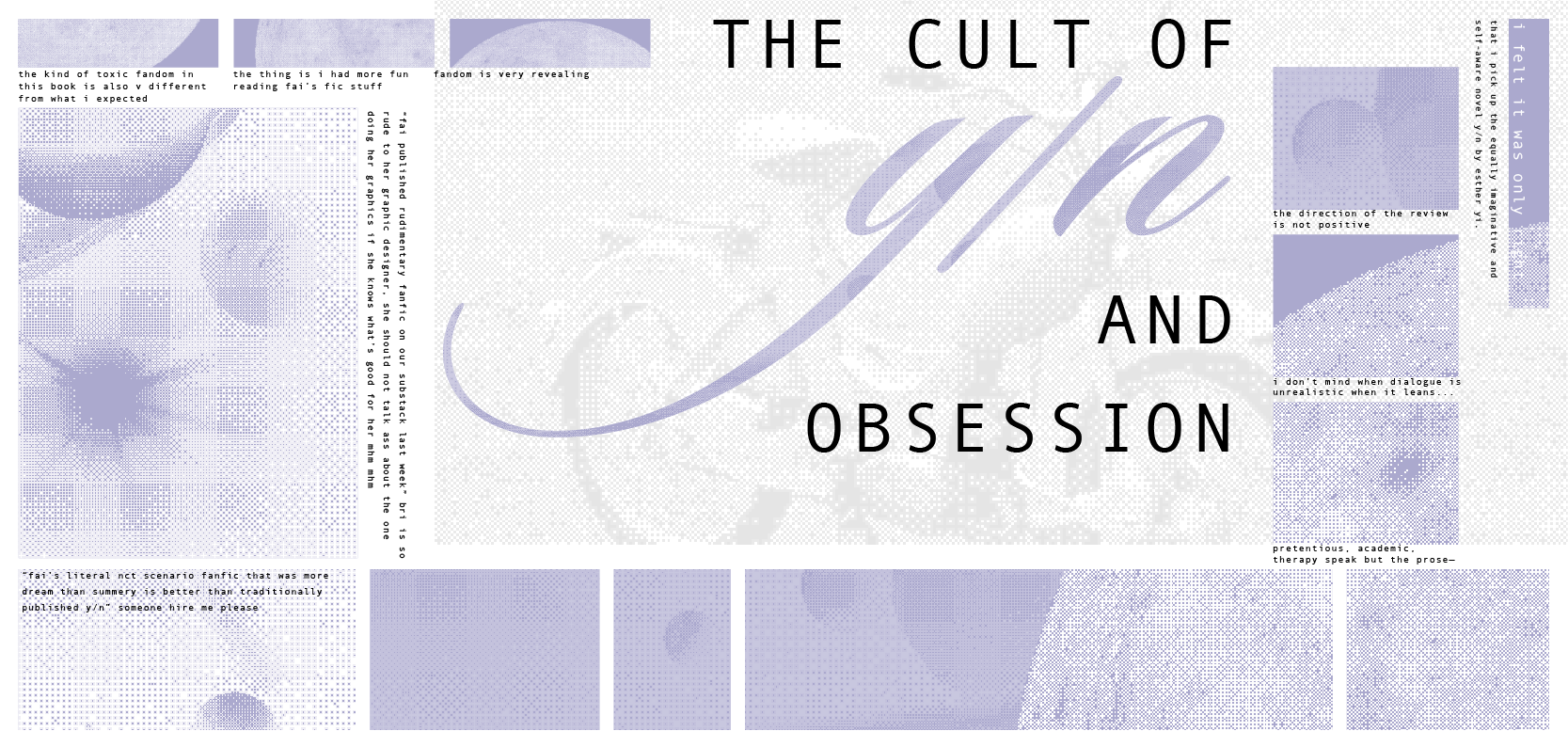
fai published rudimentary fanfic on our substack last week, so i felt it was only right that i pick up the equally imaginative and self-aware novel y/n by esther yi.
each time he uttered the abbreviation, i increasingly understood myself in the sound—the breathy insubstantiality of “why,” which was pulled down the throat by the density of “en.” he seemed to be asking “why” of my existence, “why” i was what i was.
fandom is very revealing. it essentially operates as a subculture of its own, with a language innate to its community. it is both gratifying and entertaining to turn to the corner of the internet that likes and participates in consumption. you and that network eat from the same plate. and still, we’ve all heard, seen, and felt the horrors of fandoms at their most contrived and toxic. thousands of people who need to grab hold of the reality that keeps them grounded on earth—and touch grass.
y/n explores the convergence between a your/name fanfic and a korean american woman living in berlin following the idol moon’s sudden retirement from a popular kpop group, leading to his disappearance from the public eye. this is a story where purpose is found in a series of mistranslations and misidentifications.
but thematically, its strength (and weakness) lies in the quite literal interpretation of literary protagonists who commit unusual acts of willpower, frequently to their own detriment. the narrative truly kicks off after a therapist hired by the narrator’s boyfriend tells her that if she really loved [moon], she would be in seoul right now. to which she leaves, effective immediately.
the act of writing kills quickly and from a great distance. literature murders—not the reader, as one might expect, but the characters, who are no different from real people. behind every character is person out in the world whose sanctity is violated in the process of literary transfiguration.
this story is told in three parts, stylistically: introspection, dialogue, and fanfic. everyone, simultaneously, is y/n. but the act of accepting such vacant role provides no perspective or hope or escapism, as one might find the appeal in the first place. the y/n takes the ritual perversely, in grotesque matter—so oddly that i have no choice but to reach within french vocabulary to express how gross this fascination presents itself. an act of religious devotion rather than a show of interest.
the most grounded you could feel is when the narrator’s unique case of parasocial relationships is depicted. she’s sick in a way that invites worry, not for her, but the people around her. a destructive force that sets fire to herself with the intent of letting flames catch on everyone else. metaphorically, of course. the narrator grapples with an obsession that is combative, severe—and a love that she herself confronts is conditional. she wants everything moon is and isn’t, to know him intimately and invasively.
she forces herself onto him in a numerous number of ways—disturbs moon in the place he has hidden, within the walls of sanctuary, and holds the y/n fic she wrote about him under his nose with the command to read. to understand her in ways spoken word could not convey. trust, the written word did not reveal anything we didn’t already know. the narrator exists within universality, her love was her greatest deceit.
i wish this novel could be dissected cleanly in a matter of what i found good, bad, and ugly. but this wasn’t a read that was neat at all. it took countless attempts for a size that i normally consume in one sitting. if i couldn’t appreciate the story, there must be something of substance for me to cling to. the writing, the setting, the characters. but the fact that i hold dislike for it all is where it ultimately failed me.
yet another example of concept beating execution in terms of intrigue.
here moon was, setting before me ideas of indisputable rationality, like utensils arranged in order, polished and practical, when he was supposed to be coaxing my imagination into its deepest contortions.
i don’t mind when dialogue is unrealistic if it leans pretentious, academic, therapy speak, but the prose here is… uninspired. and 9/10 it was when words came from the characters’ mouth! it was a drawl and droning and terrible poeticism.
we follow the narrator as she wreaks emotional havoc across korea, meeting a series of side characters with no face or physicality who follow her like sunken souls. they ruminate on perhaps the most incorrect interpretations of her character. they speak from a thesaurus and try to make great critique about the world. their musings have no weight when i’m skimming the page for something tangible to work my brain and tongue around. everyone trips and falls and acts like they’re flying.
the narration had more sense of voice. yi’s prose is better to examine when you don’t know whether to take it seriously or not. does she subvert any of the commentary made or align this character study with satire? no, i don’t think so. she only mends the most extreme of conventions for, what, shock factor perhaps. going beyond the meaning of toxic for the sake of portrayal is a testament of creativity within itself.
i suppose there is a redeeming quality to this work, two chapters away from its ending. moon finally has personal lines and in them, the sense of rationale and meanness and urgency needed to yank the floor out from under the narrator’s feet, thus sending all of her ill-advised delusions to the floor. this moment of satisfaction—mind you, the only point of the novel where i felt invested—was immediately yanked away from me with perhaps one of the worst phallic descriptions, and by the last pages, no consequence.